How to Compare Industrial Properties Effectively
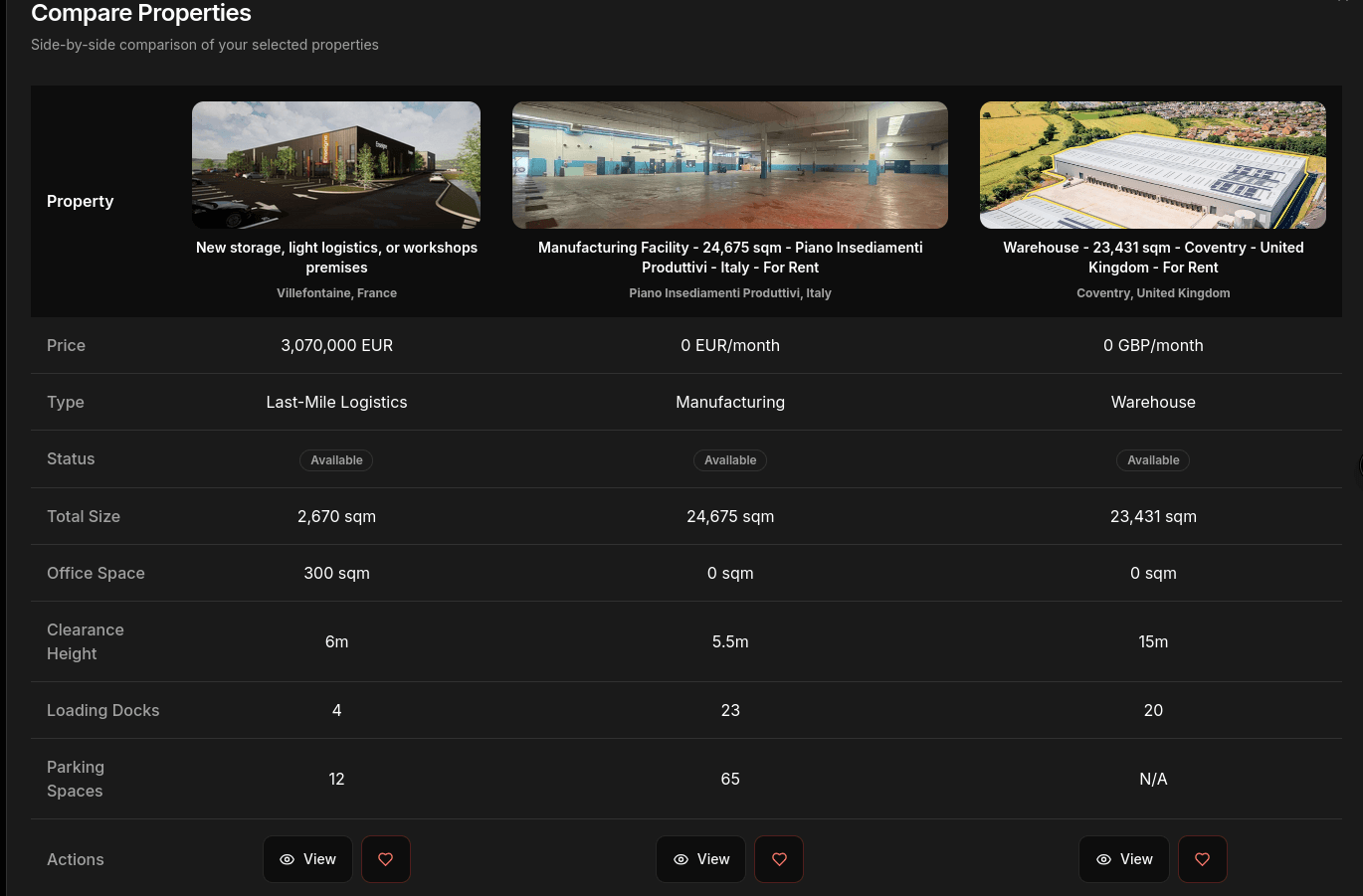
Comparing properties is critical. Make the wrong choice and you're stuck with it for years.
This guide shows you how to compare properties effectively and make better decisions.
Why Comparison Matters
A bad property decision costs more than rent:
- Operational costs: Wrong location adds transport expenses
- Hidden costs: Unexpected repairs or upgrades
- Growth limitations: Can't expand when needed
- Opportunity cost: Better properties you missed
The cost: €50,000+ over a 10-year lease
Compare properly. Make informed decisions.
Comparison Framework
Step 1: Save Favorites
Build your comparison list:
- Search properties using your criteria
- Review property details
- Click "Save" or "Add to Favorites"
- Repeat for 3-5 properties
- Access favorites from your dashboard
Tip: Start with 5-10 properties, then narrow to 3-5 finalists.
Step 2: Compare Key Criteria
Evaluate properties on these factors:
Location
- [ ] Supply chain fit: Does it fit your network?
- [ ] Customer proximity: Distance to key customers
- [ ] Transport access: Highway, port, airport proximity
- [ ] Market coverage: Serves your target markets
Physical Specifications
- [ ] Size: Meets your square meter requirements
- [ ] Ceiling height: Sufficient for operations
- [ ] Floor loading: Weight capacity adequate
- [ ] Dock doors: Sufficient loading bays
- [ ] Office space: Adequate office facilities
Access and Operations
- [ ] Access hours: Matches your needs (24/7, etc.)
- [ ] Security: Gated, CCTV, security personnel
- [ ] Loading facilities: Grade-level, dock-high access
- [ ] Parking: Adequate parking space
Costs
- [ ] Base rent: Monthly or annual rent
- [ ] Service charges: Additional fees
- [ ] Utilities: Electricity, water, heating
- [ ] Total cost: Complete cost picture
Step 3: Score Each Property
Rate properties on your priorities:
Scoring system:
- 5 = Excellent (exceeds requirements)
- 4 = Good (meets requirements well)
- 3 = Acceptable (meets basic requirements)
- 2 = Poor (below requirements)
- 1 = Unacceptable (deal-breaker)
Example scoring:
| Criteria | Property A | Property B | Property C | |----------|------------|------------|------------| | Location | 5 | 4 | 3 | | Size | 4 | 5 | 4 | | Access | 5 | 3 | 4 | | Cost | 3 | 4 | 5 | | Total | 17 | 16 | 16 |
Step 4: Identify Deal-Breakers
Eliminate properties with deal-breakers:
- Wrong location: Doesn't fit supply chain
- Too small: Can't accommodate operations
- Access issues: Insufficient loading facilities
- Cost over budget: Exceeds financial limits
- Legal problems: Zoning or permit issues
Remove these immediately. Don't waste time on unsuitable properties.
Comparison Strategies
Strategy 1: Must-Haves First
Start with non-negotiable requirements:
- List must-haves: Essential requirements
- Eliminate: Properties missing must-haves
- Compare remaining: Evaluate nice-to-haves
- Make decision: Choose best overall fit
Strategy 2: Weighted Scoring
Weight criteria by importance:
Example weights:
- Location: 30%
- Size: 25%
- Cost: 20%
- Access: 15%
- Other: 10%
Calculate weighted scores. Highest score wins.
Strategy 3: Pros and Cons
List pros and cons for each property:
Property A:
- Pros: Great location, good access, right size
- Cons: Higher rent, older building
Property B:
- Pros: Lower rent, newer building, good condition
- Cons: Further from customers, limited access
Compare lists. Choose best balance.
Using IndiFind for Comparison
IndiFind makes comparison easy:
Save Favorites
- Search properties
- Click "Save" on interesting properties
- Access from dashboard
- Compare side-by-side
View Details
Each property listing includes:
- Complete specifications
- Location details
- Pricing information
- Access requirements
- Contact information
Direct Enquiry
Contact listers with questions:
- Request additional information
- Schedule viewings
- Negotiate terms
- Get clarification
Common Comparison Mistakes
Price-only focus:
- Choosing cheapest without evaluating fit
- Better: Consider total cost and operational fit
Ignoring hidden costs:
- Not accounting for all fees
- Better: Get complete cost breakdown
Too many options:
- Comparing 10+ properties
- Better: Focus on 3-5 finalists
Analysis paralysis:
- Overthinking every detail
- Better: Use scoring system, make decision
Decision Framework
Must-Haves
Properties must meet these:
- Right location
- Adequate size
- Sufficient access
- Within budget
Nice-to-Haves
These improve the decision:
- Newer building
- Better condition
- More office space
- Lower costs
Deal-Breakers
These eliminate properties:
- Wrong location
- Too small
- Access problems
- Over budget
Real Results
Effective comparison delivers:
- Better decisions: Choose properties that fit
- Cost savings: Avoid expensive mistakes
- Operational efficiency: Right location and facilities
- Growth support: Properties that scale with you
Next Steps
Ready to compare properties?
- Sign up for free
- Search properties using your criteria
- Save favorites (3-5 properties)
- Use this comparison framework
- Make informed decision
Compare effectively. Choose wisely. Get started now.
About IndiFind: Compare industrial properties side-by-side. Save favorites. Evaluate effectively. Make informed decisions. Free forever.
Tags
Read Next
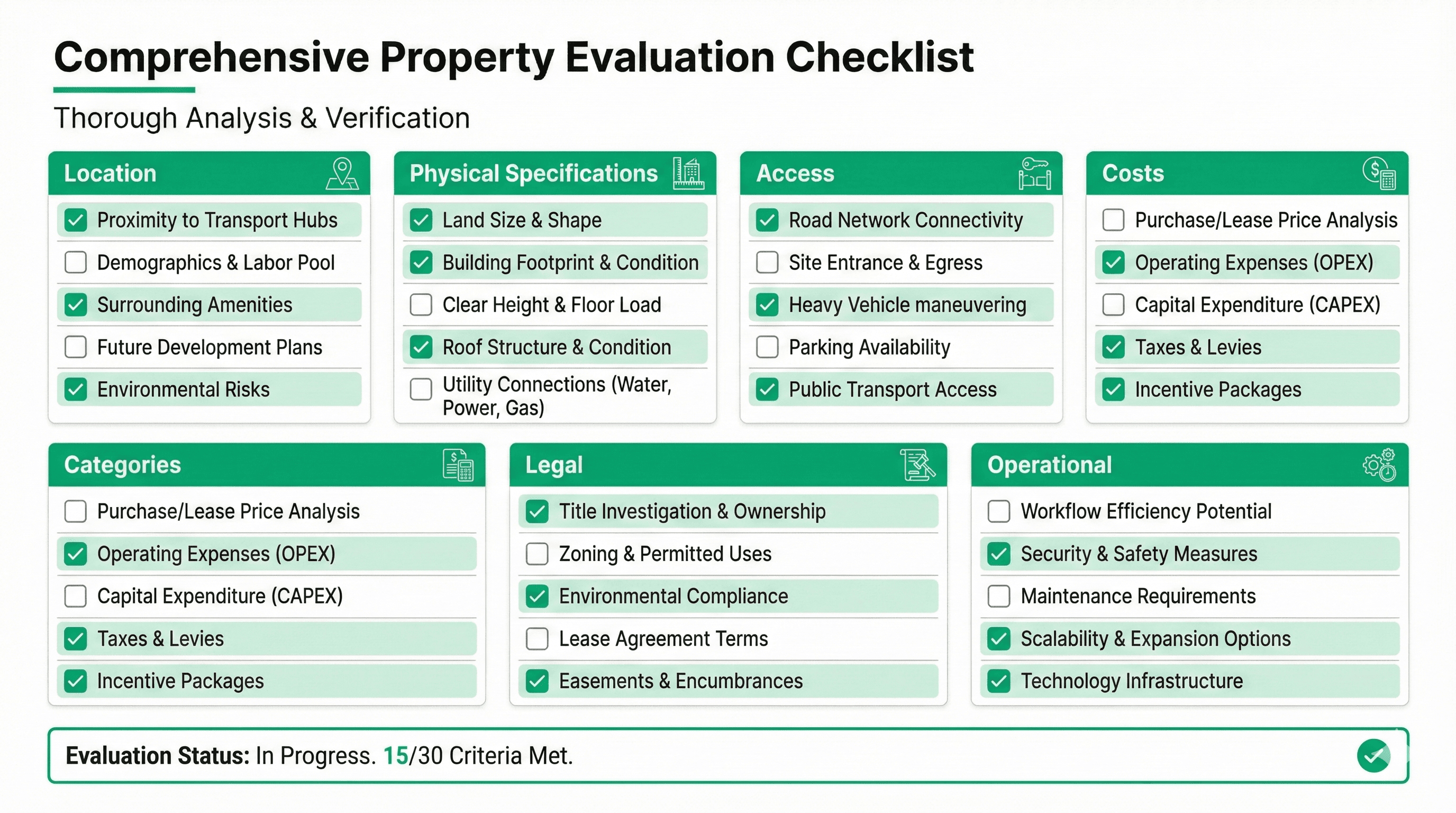
Industrial Property Evaluation Checklist
Use this comprehensive checklist to evaluate industrial properties. Avoid costly mistakes and make informed decisions when selecting warehouse and logistics facilities.

Warehouse Industrial for Rent: Complete European Guide
A complete, data-driven guide to renting industrial warehouse space in Europe: specifications, costs, lease terms, location strategy, and the exact process to secure the right facility with less risk and less wasted time.

Warehouse Lease Terms in Europe: What to Watch
A practical breakdown of the lease clauses that control risk, flexibility and cost when renting industrial warehouse space across European markets.